🇬🇧 A few words about Astra dice
For some time now, I’ve been working on some role-playing game projects that are a bit more ambitious than what I’m used to, and with these ambitions come deeper reflections on what I like to play, how I like to play, and of course the age-old question: d20 or d10? (the answer is never d10)
Kidding aside, ever since I discovered Hollow Earth Expedition (HEX) a long time ago, I’ve been drawn to the idea of dice pool systems. In HEX, the dice are binary: you roll a certain number of dice (depending on the skill used), and every even result counts as a Success, whilst odd results count for nothing. Funnily enough, you can use any standard polyhedral die for this roll!
The number of Successes one can expect to obtain in this system depends on the number of dice rolled, in accordance with the well-known binomial distribution—the famous ‘bell curve’—and, on average, one can expect to obtain roughly half as many Successes as the number of dice rolled. The more dice you roll, the more accurate this prediction becomes, to the extent that, to streamline the system and avoid rolling a gazillion dice (this isn’t Warhammer Battle, after all), once you reach a certain skill level, you don’t roll the dice if the difficulty (i.e. the number of Successes needed to complete the action) is less than half the number of dice to be rolled. Note also that with a system like this, getting a very low or very high number of Successes is akin to a statistical miracle: this is a critical roll that truly lives up to its name!
Okay, so all this is great, but I feel that binary dice lack a bit of surprises. They lack different ways of interpreting the rolls. That’s how the idea for Astra dice began to take shape, as well as the Astra system, a generic system that I plan to develop in my future creations and which uses these dice.
So, what exactly is an Astra die? It’s a die with three distinct faces (each repeated twice, to make a d6!):
- 1 side with a full Star
- 1 side with a half Star
- 1 blank side
One Star = 1 Success. So, two half-Stars = 1 Success; but a single half-Star = nothing at all. As far as I am aware, these unusual dice (and this way of interpreting them) do not exist anywhere else. They have a whole range of nice features, but here are the ones that interest me most:
- overall, the same intuitions apply as with binary dice; the averages are similar, although Astra dice perform ‘slightly worse’ (but you simply need to adjust the difficulty scale to account for this). In particular, two Astra dice are strictly stronger than a single Astra die: rolling an even number of Astra dice provides a slight advantage over rolling an odd number.
- it is easy to implement an advantage/disadvantage mechanic that does not require re-rolling the dice: an advantage allows ‘half Star’ faces to be converted into ‘full Stars’, whilst a disadvantage turns them into blank faces. This also offers a narrative interpretation of the result, assuming that advantages/disadvantages represent external circumstances or influences, and the number of dice rolled represents the character’s ‘intrinsic’ skill: this way, a roll with many Stars but few half-Stars suggests that the majority of Successes stem from the character’s skill, despite their environment. Conversely, a majority of half-Stars highlight a more pronounced importance of context: an advantage or disadvantage can make or break the action!
- finally, because you can physically handle Successes, there’s no need for calculations: a system that allows you to spend Successes (as I do in the Astra system) to achieve various mechanical or narrative effects lets you treat the dice like currency, without having to bother counting the number of Successes. There will be more to say on this another time, but this allows me, in particular, to provide rich tactical experiences, akin to D&D or Pathfinder, but without any complex calculations!
So, you might say, all this is well and good, but what’s the point if the dice don’t exist? To that I would say, not so fast, for you have options:
- standard d6 are easy to use (1-2: nothing, 3-4: half-Star, 5-6: Star), although you do need to get used to reading the results, which takes a little time;
- Fate/Fudge dice are perfect for this purpose (a ‘-’ counts as a half-‘+’!);
- you can put stickers on old or blank dice (that’s what I did at home!);
- but most importantly, I had you in mind when I developed an app – a virtual dice roller – that lets you try roll Astra dice on your browser and on your mobile! It's here.
I have lots of projects involving Astra dice: several games I want to develop, but also the Astra system, which will be released under an open licence so you can reuse it! We'll talk more about this soon. In the meantime, feel free to have a go with the virtual dice roller (and let me know if you spot any bugs I might have missed) and if you’d like to use Astra dice in your games, do get in touch – I’d be really happy to see this idea catch on.
Let me leave you with a screenshot of the app, which shows an example of a roll in action (here, 10 dice, although I would rather aim for an average of between 3 and 5).
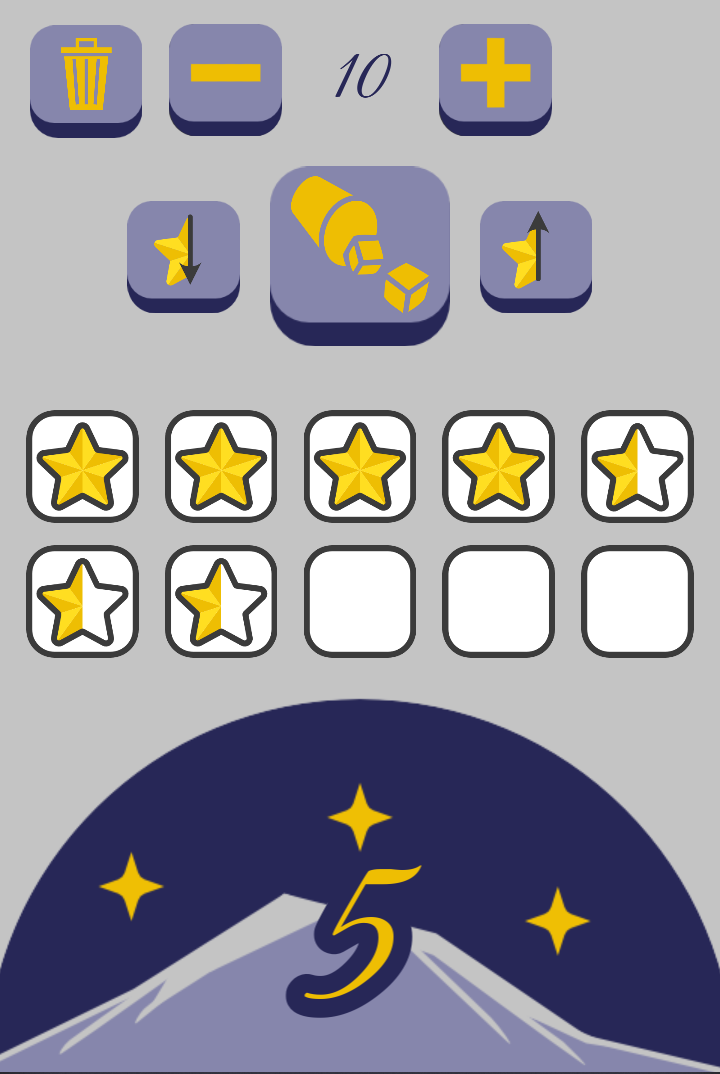
So here we get 5 Successes (4 Stars + 2 half-Stars); with the advantage, however, we would have had 7! And with the disadvantage, only 4. It’s as simple as that.